

Why Guimarāes is Europe’s Green Capital for 2026
I recently had the pleasure to spend time in the small historic city of Guimarāes, in northern Portugal, which is the current European Green Capital.
For those who don't know much about Guimarāes, it's a small city with a population of around 157,000, located 1 hour from both Porto and Braga (pop. 156,000) in a valley surrounded by rolling green forested hills. It is known as the birthplace of Portugal (“Cidade Berço” in Portuguese), due to being the birthplace of Portugal's first King, Afonso Henriques, in 1109, and also because the Battle of São Mamede - which led directly to the establishment of the Kingdom of Portugal - was fought close to the city in 1128.
The city centre of Guimarāes is one of the most complete and well-preserved mediaeval towns in Europe, retaining parts of the original city wall & gates, and a 10th Century castle. It has been a UNESCO World Heritage Site since 2001, with the inscription being extended in 2023 to include the historic industrial neighbourhood of Couros, an 18th Century centre of the leather tanning & dying industry, whose specialised building design & industrial techniques were exported across the then-Portuguese Empire in Africa and Asia. It is no surprise that it was designated European Capital of Culture in 2012, and was voted by the famous international travel magazine, Conde Naste, “most beautiful small city in Europe” in 2022.

Guimarāes mediaeval historic centre, UNESCO World Heritage Site (© Kerri Farnsworth)
But none of this explains why it is the current European Green Capital.
After the success of its year as European Capital of Culture, the city’s then-political leadership decided to create a partnership with the region’s 2 universities, Universidade do Minho and Universidade de Trás-os-Montes e Alto Douro, to develop joint research facility in ecology and hydrology, known as Laboratória da Paisagem (‘the Landscape Laboratory’). But they quickly realised in trying to communicate their work that there was a big gap in educating local citizens, businesses and other stakeholders. So they developed PEGADAS, an award-winning transversal environmental education & communications programme aimed at all ages and all delivery formats.
The Lab now has a multidisciplinary team of 30 biologists, geologists, landscape architects, public health professionals, geographers, hydrologists, psychologists, educators, arboriculturists and communicators, promoting environmental sustainability through 3 pillars:-
scientific research
communication, education & training; and
territorial management and consultancy, including management of all green & blue infrastructure

Laboratória de Paisagem: river ‘living lab’ and eco-mural created with waste materials (© Kerri Farnsworth)
Among the city’s achievements to date include:-
early commitment to achieving major environmental goals eg. introducing policy in 2014 that all new public buildings had to be Net Zero (the first in Portugal and one of the first in Europe), and committing in 2017 to be a climate neutral city by 2030
creating an additional almost 100 hectares of public high-quality greenspace , including green and blue corridors which mitigate & manage climate change impacts such as flood risks, heatwaves, etc
significantly reducing air pollution, such that 97% of the population now have “excellent” air quality
developing a unique pilot - “Bairro C” - to create the world’s first Net-Zero neighbourhood in a UNESCO World Heritage Site, by making it a testbed for a range of world-leading innovative solutions
its ‘One Planet’ approach, which has seen sustainability integrated into daily life through circular economy strategies, including Portugal’s first ‘Pay-as-you-Throw (PAYT) waste charging policy; promotion of biodiversity; and fostering strong community engagement & inclusion through initiatives such as citizen science and ‘Green Brigades’ (Brigadas Verdes), citizen volunteers who help to manage & expand the city’s green infrastructure
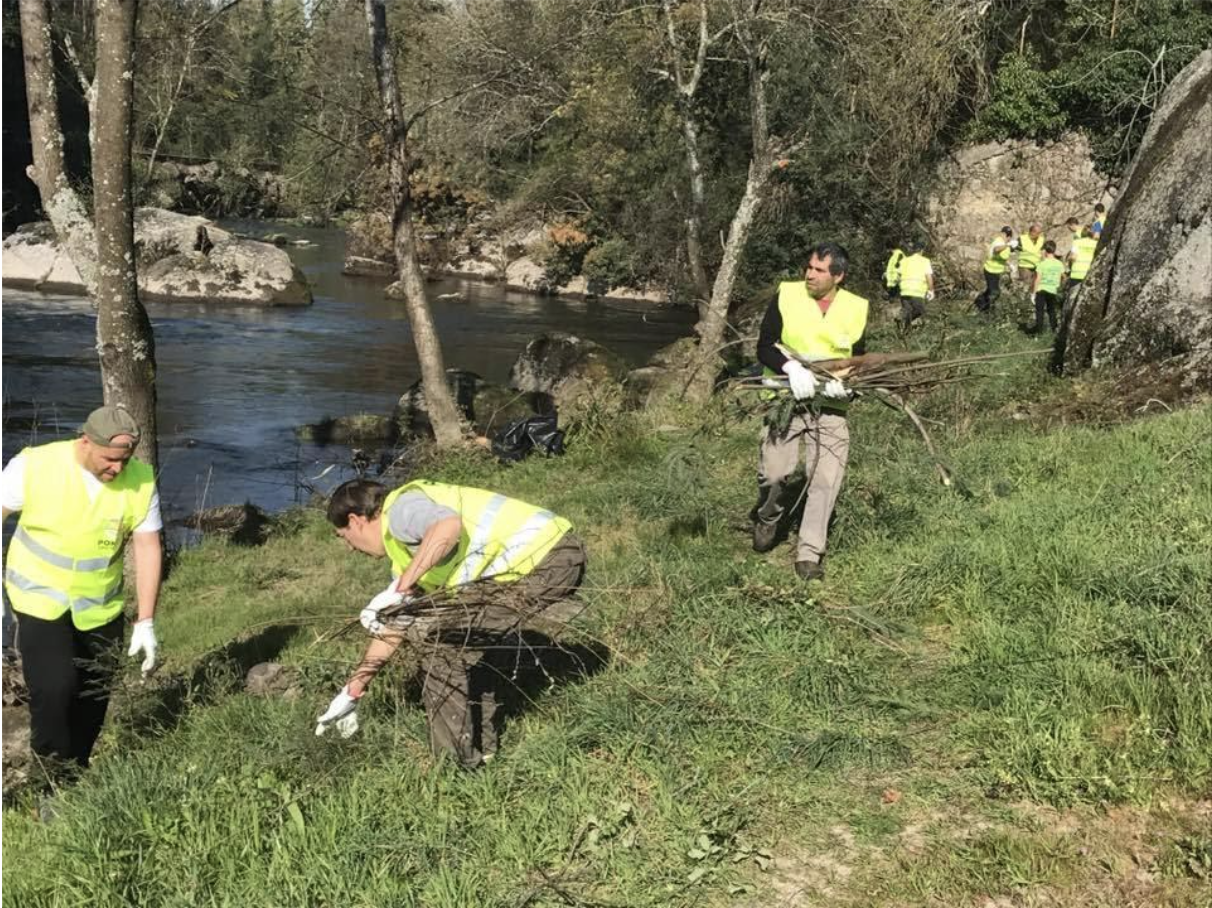
Guimarāes’ ‘Green Brigades’ (Brigadas Verdes) citizen volunteers managing riverbanks (© Junta de Freguesia Ponte)
One thing that impressed me most was the Lab were achieving all of this, along with serious, robust contributions to advancement in academic science, whilst also retaining a sense of humour and fun - for example, developing a citizen science game based on the famous Pokemon, Biodiversity GO! , to help users identify, catalogue & track biodiversity.
This unique, and impactful, commitment to holistic, inclusive sustainability is truly impressive, especially in a country which has a long way to go to meet European benchmarks on many sustainability metrics.
And that’s why Guimarāes was awarded the title of European Green Capital for 2026.